 EMIS
EMIS Job Portal
 Ongoing
Merit based recruitment through NTS - 2014
Merit-Based Recruitment through NTS: A Landmark 2014 Notification of the School Education Department, Government of Balochistan
Overview
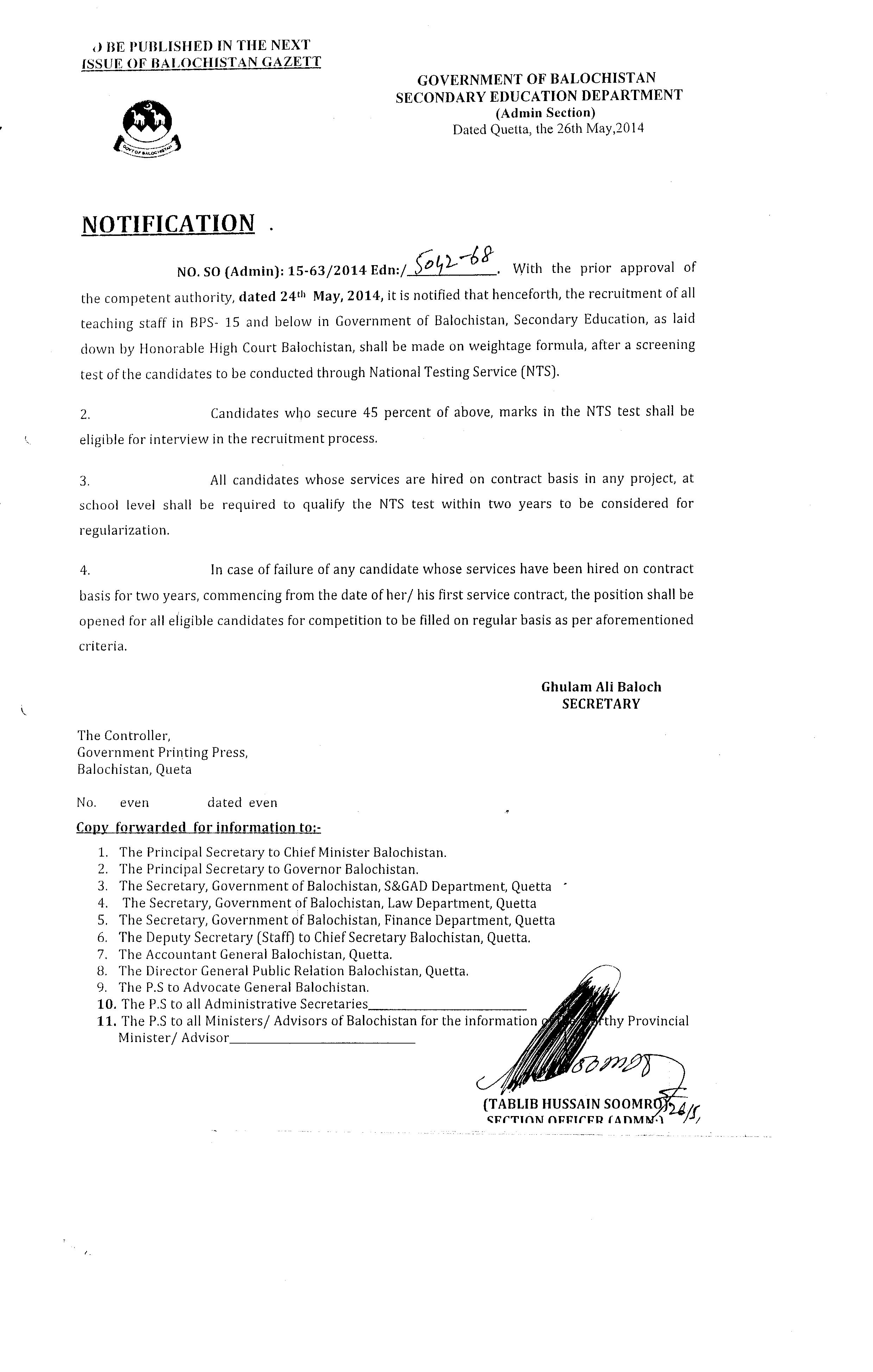
In a landmark decision to reform its education system, the Government of Balochistan, under the leadership of Chief Minister Dr. Abdul Malik Baloch, formally integrated the National Testing Service (NTS) into the teacher recruitment framework. This policy shift was officially ratified through a formal notification issued by the School Education Department in November 2014, mandating that all future recruitments for government teaching positions would be conducted through NTS to ensure merit, transparency, and quality in the province’s classrooms.
The 2014 notification represented a radical departure from previous practices, which had been plagued by political patronage and corruption. At the time of the notification, the education department was grappling with over 6,500 vacant teaching posts, many of which existed in remote districts like Panjgur and Chagai. Furthermore, 71% of Balochistan's population lived in multidimensional poverty, making access to fair public sector jobs a critical issue for the province's educated youth.
The 2014 Notification: Policy Framework and Key Details
The 2014 notification and its subsequent addendums established a structured, multi-tiered framework for filling teaching positions across the province.
1. Scope and Vacancies
The notification initially announced the recruitment of 1,600 science and IT teachers for high schools across the province. However, this number was rapidly expanded, with the government committing to fill all outstanding vacancies. By the end of the year, a total of 4,259 vacant posts were officially announced through the NTS, covering various cadres including Junior Vernacular Teachers (JVT), Senior English Teachers (SET), Junior English Teachers (JET), and others.
2. Eligibility and Rationale
The recruitment drive was designed to be inclusive. Under the 2014 policy, possessing a professional teaching degree (B.Ed./M.Ed.) was not made mandatory for all applicants, a deliberate decision to attract talented subject specialists who lacked formal teacher training. Instead, the policy allocated additional marks to candidates holding professional degrees, while allowing all otherwise qualified individuals to appear in the NTS test.
-
Key Eligibility Shift: This "open door" policy was a strategic response to the acute teacher shortage, aiming to bring capable graduates into the system quickly while still incentivizing professional qualifications.
Merit-Based Recruitment Process (As per Notification)
The 2014 notification's core mandate was the "outsourcing" of the testing phase to a neutral third party. The NTS was hired to conduct the standardized tests, a move aimed at eliminating the political influence and bribery that had historically plagued departmental exams. The selection process was composed of two primary components:
-
NTS Test (100 Marks): All candidates had to appear in a standardized NTS examination, which assessed their subject knowledge and general aptitude.
-
Academic Qualifications (100 Marks): Marks were assigned based on the candidate's academic record (Matric, F.A./F.Sc., Bachelor's, and Master's degrees).
A combined merit list was generated based on the cumulative score out of 200. This list was then geographically filtered on a Union Council (UC) basis, where candidates were prioritized based on their proximity to the specific schools where vacancies existed.
Implementation and Challenges
Despite the government's stated intentions for transparency, the execution of the 2014 notification faced severe administrative hurdles and public criticism, which ultimately diluted the impact of the merit-based reform.
1. The "Ghost Vacancies" Controversy
The most significant flaw in the implementation was the lack of transparency regarding Union Council quotas. While the NTS test was conducted nationwide, the government failed to disclose how many vacancies existed in each UC before the exams. Consequently, over 93,000 applications were submitted, with candidates spending Rs. 1,000 per application (generating over Rs. 100 million in fees), only to later discover that there were no vacancies available in their specific UCs.
2. Allegations of Manipulation
Political interference persisted despite the NTS contract. Allegations arose that sitting politicians and bureaucrats had transferred existing teachers to create artificial vacancies in areas under their political influence, thereby engineering a situation where their preferred candidates could top the UC-specific merit list.
3. Failed Appointments and Protests
The gap between the merit list and actual appointments led to widespread unrest. By 2015 and 2016, over 332 UC-level toppers across various districts had not received appointment letters. The government established District Recruitment Committees (DRCs) and Central Recruitment Committees (CRCs) to handle post-test procedures; however, these bodies were accused of bypassing the published NTS merit scores to appoint favored individuals. This led to a twenty-month-long protest by candidates outside the Quetta Press Club, culminating in the tragic suicide of a successful candidate in Panjgur in 2018.
Impact and Legacy
The 2014 notification initiated the first widespread, third-party-verified teacher recruitment in Balochistan's history.
-
Positive Outcomes: The drive successfully filtered out thousands of unqualified applicants, and many capable candidates from middle-class backgrounds were appointed. The Chief Minister claimed that the NTS process was a "miracle" that restored public trust in government hiring.
-
Systemic Lessons: The failure to fully implement the merit list exposed the limits of simply hiring a testing service when the downstream administrative processes (quota allocation, district-level vetting) remain vulnerable to manipulation.
-
Policy Volatility: The 2014 framework was later dismantled by subsequent governments. By 2019, a new policy restricted applications to only those with professional degrees. A decade later, the province continues to oscillate between NTS-driven meritocracy and localized, often nepotistic, hiring practices.
Administrative Framework: Reforms in Governance
Beyond testing, the 2014 government attempted to support the notification with structural governance reforms:
-
Budget Allocation: For the first time in the province's history, 24% of the annual budget was allocated to the education sector, though a large portion was absorbed by salaries rather than development.
-
Digital Oversight: The administration launched a dedicated website to identify and eliminate "ghost schools" and "ghost teachers," attempting to create a verifiable database of institutions and employees.
-
BPSC Reforms: Simultaneously, the government reformed the Balochistan Public Service Commission, which subsequently recruited 700 lecturers and 1,200 additional staff through more transparent means.
Conclusion
The 2014 Notification for Merit-Based Recruitment through NTS remains a landmark document in Balochistan’s educational history. While its implementation was marred by administrative incompetence and political resistance, it successfully established the legal and procedural principle that teacher recruitment cannot be left to patronage. For the youth of Balochistan, the notification represented a promise of equal opportunity—a promise that, despite being only partially fulfilled, continues to serve as the benchmark against which all subsequent recruitment drives are measured.
Key Data Summary
| Aspect | Details |
|---|---|
| Notification Date | November 2014 |
| Total Vacancies | 4,259 initially (expanded to 6,500+) |
| Testing Agency | National Testing Service (NTS) |
| Test Fee | Rs. 1,000 per application |
| Total Applications | ~93,000 |
| Marks Distribution | NTS Test: 50% (100 marks) / Academics: 50% (100 marks) |
| Controversy | 300+ UC toppers left unappointed; protests and legal challenges |
| Total Revenue Generated | Over Rs. 100 million from application fees |
Document Access
The complete archive of notifications and policy documents related to the 2014 Merit-Based Recruitment through NTS can be accessed through the official School Education Department, Government of Balochistan website: https://sed.gob.pk/
Last updated: May 2026
This document is part of the archival record of education sector reforms in Balochistan.